The Hastings and Prince Edward Regiment
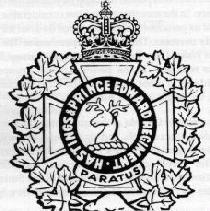
Armorial Description
Between two sprays of maple leaves, a Maltese Cross; below the Cross and
joining the base of the sprays, a beaver facing dexter, on a log. Between the
points of the sprays and surmounting the upper arm of the Cross, the Crown.
Upon the Cross an annulus inscribed HASTINGS AND PRINCE EDWARDS REGIMENT:
within the annulus a stag's head, facing dexter, upon a wreath. Below the
annulus a scroll bearing the motto PARATUS.
Official Abbreviation: Hast & PER
Motto: Paratus (Ready)
Battle Honours (40)
Early History
First World War
Mount Sorrel
Somme, 1916
Arras, 1917, '18
HILL 70
YPRES, 1917
AMIENS
HINDENBURG LINE
PURSUIT TO MONS
Second World War
Landing in Sicily
Grammichelle
Valguarnera
ASSORO
Agira
Adrano
Regalbutto
SICILY, 1943
Landing at Reggio
Motta Montecorvino
CASSINO II
Gustav Line
Liri Valley
HITLER LINE
GOTHIC LINE
Lamone Crossing
Misano Ridge
RIMINI LINE
SAN FORTUNATO
Bulgaria Village
Campobasso
Torella
THE MORO
San Leonardo
The Gully
Ortona
Naviglio Canal
Fosso Vecchio
ITALY, 1943-1945
Apeldoorn
NORTH-WEST EUROPE, 1945
Authorized Marches:
I'm Ninety Five
Regimental Headquarters:
Belleville Ontario
Outlying Locations:
Peterborough ONT
Cobourg ONT
Organization:
Assoro Coy (Belleville)
Moro Coy (Peterborough)
Cassino Coy (Cobourg)
Somme Coy (Admin and Log, divided among all 3 locations)
Misc Info:
The Regimental mascot is a near life-sized wooden indian named: "Chief Petawawa-Much"
The Regiment has a tradition: When a member or former member dies they are said to have transferred to "The White Battalion."
The Cap badge of the Hast Per is backed in crimson.
The Hast & PER received the most Battle Honours of all Canadian
regiments during the second world war. (31 in total for this campaign)
The official regimental nickname: "The Ploughjockies" earned during WWII, given at first antagonistically by some of the Toronto Regiments because of the Hasty P's rural roots. It became a mark of distinction as the unit's fighting prowess became well known.
B Coy (present day Moro Coy) was reactivated with the reduction to
nil strength, and subsequent disbandment of The Peterborough Rangers,
Royal Canadian Artillery. This Battery had made it's home in the
Peterborough armoury, from the time of it's construction. (I believe in
1915).
The book "The Regiment" was written by Farley Mowat, a former Intelligence officer (also serving as an Infantry officer), and member of the Regiment during WWII.
Order of Precedence: 9
Go back to the Infantry Regiments page.
Go back to the Army home page.
Options
Go back to the Infantry Regiments page.
Go back to the Army home page.
|



 Navy.ca Forums