Navy.ca's Fallen Comrades

They shall grow not old, as we that are left grow old


The Royal Montreal Regiment
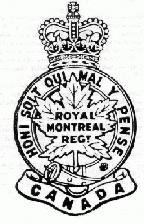


Armorial Description

A mapie leaf inscribed ROYAL MONTREAL REGT within the Garter and motto HONI SOIT QUI MAL Y PENSE surmounted by the Crown and resting on a scroll bearing the word CANADA.


Official Abbreviation: RMR

Motto: Honi Soit Qui Mal Y Pense (Evil to he who evil thinks)


Battle Honours (25)

First World War

    YPRES, 1915,'17
    Arleux
    Gravenstafel
    Scarpe, 1917, '18
    ST. JULIEN
    Hill 70
    FESTUBERT, 1915
    PASSCHENDAELE
    MOUNT SORREL
    AMIENS
    SOMME, 1916
    DROCOURT-QUTANT
    Pozieres
    Hindenburg Line
    Thiepval
    CANAL DU NORD
    Ancre Heights
    Pursuii To Mons
    Arras, 1917,'18
    France and Flanders, 1915-18
    VIMY, 1917
Second World War
    CALAIS, 1944
    LEOPOLD CANAL
    THESCHELDT
    NORTH-WEST EUROPE, 1944-1945
Colonel-in-Chief: None

Authorized Marches:
Quick March: Ca Ira

Regimental Headquarters:
4625 St. Catherine Street West
Westmount, Quebec
H3Z 1S4

Location of Sub Units: Westmount, Quebec

Alliances:
The Prince of Wales' Own
Regiment of Yorkshire
Imphal Barracks
York, England


Order of Precedence: 45

Options

Go back to the Infantry Regiments page.
Go back to the Army home page.
Military Word Of The Day
CE Round
:
Chemical Energy Round - Ammunition that uses explosive to create terminal effects on target and is effective regardless of range or velocity. Examples include HEAT, HESH, MPAT and HE-FRAG.


» Download the iPhone/iPad Military Terms app! «


Today in Military History

February 25


1787:

1st Battalion, The Royal New Brunswick Regiment (Carleton and York), specific date of origin not known


1838:

Amherstburg Ontario - Canadian militia routs American republican sympathizers on Fighting Island, in the Detroit River


1867:

A.G.L. 'Andy' McNaughton 1867-1966


1870:

2nd Battalion, The Royal New Brunswick Regiment (North Shore): Spem Reduxit (Hope restored)


1917:

During fighting along the banks of the Tigris in Mesopotamia, troops from the South Lancashire Regiment (British Army) repeatedly attempted to advance along a gully, but suffered heavy casualties each time from a Turkish machine-gun.  Private Readitt took part in each of five attacks, and on each occasion was the only survivor.  However, the attacks slowly forced the Turks to give ground.  When the officer commanding the operation was killed, Readitt when forward once more, alone and on his own initiative.  He advanced right up to the Turkish position, and although he was unable to remain there for long, he inflicted damage with grenades.  He slowly retired, and located a good defensive position a short distance away, which he proceeded to hold on his own.  Eventually, other soldiers managed to advance and join him, and consolidate the position.  Readitt was awarded the Victoria Cross.


1941:

British troops occupied the capital Mogadishu, as Italian resistance in Somaliland collapsed.


1944:

Bomber Command mounted a devastating attack on Augsburg, the first occasion it had attacked that city in strength. Good weather and poor anti-aircraft defence contributed to a very concentrated attack by 594 aircraft carrying more than 2,000 tons of bombs. The raid proved somewhat controversial, given the level of destruction in the old city centre. Some 700 Germans were killed, but perhaps 90,000 rendered homeless. An important aircraft component factory was successfully damaged, as well as factories associated with the MAN engineering works, which produced U-boat engines.


1945:

Following fierce fighting in Holland, a platoon of The Queen's Own Rifles of Canada had been reduced to just one sergeant and four men during a series of German night counter-attacks. Sergeant Cosens positioned the four riflemen to give him covering fire, then ran to a supporting tank. Standing fully exposed on the tank, he directed its fire to good effect, breaking up another attack. He than asked the tank to bulldoze a way into a German-occupied farm. Cosens went into the farm alone and killed or captured all its defenders. He then succeeded in clearing another two buildings on his own, and was killed by a sniper.


1991:

During the Persian Gulf War, an Iraqi Scud missile hit a U.S. barracks in Dhahran, Saudi Arabia, killing 28 Americans.


» Download the iPhone/iPad Military History app! «


Advertising